Legacy System Modernization Without Breaking the Business: A 6-Step Playbook

Key takeaways
- The biggest risk in legacy modernization is not the new system — it is the transition period where both run in parallel.
- Big-bang rewrites fail. Strangler-fig migration succeeds because each slice is reversible.
- Discovery is 20% of the effort and 80% of the outcome. Skip it and you rebuild the same limitations in a new stack.
- A modernization roadmap that cannot ship value inside 90 days should be re-scoped.
- Data is the hardest part, not the code. Plan the cutover before you plan the build.
Every mid-market company we work with has at least one system that everyone agrees needs to be replaced — and nobody wants to be the person who touches it. It is running payroll, dispatch, billing, or scheduling. It works. It also blocks half the roadmap, breaks every integration, and requires one specific person to hold it together.
This is the modernization problem, and the failure rate is high because most organizations attempt it the wrong way. Below is the risk-managed playbook we use to replatform load-bearing systems without breaking the business.
Why modernization projects fail
Legacy modernization fails for four repeatable reasons, in roughly this order:
- 1The team commits to a big-bang rewrite and burns 18 months before anything ships.
- 2Discovery is skipped, so the new system faithfully reproduces the constraints of the old one.
- 3Data migration is treated as a last-week task and quietly consumes the last two months.
- 4There is no rollback plan, so the first production incident forces a permanent retreat to the legacy system.
The 6-step playbook
1. Diagnose the outcome, not the technology
Start with the business outcome the legacy system is blocking — faster onboarding, cheaper transactions, new-market expansion, compliance, integration with a modern partner. That outcome is the yardstick every downstream decision is measured against. If the outcome is not clear, the project is not ready.
2. Map the real system, not the documented one
The system that runs the business is never the system that is documented. Sit with the actual users, map the workarounds, catalog the shadow spreadsheets, and identify the tribal knowledge. This is discovery, and it is the single most under-invested step in modernization.
3. Slice by capability, not by module
Divide the target system into the smallest slices that can each deliver standalone value — a single capability, end-to-end. Not a database layer this quarter and a UI layer next quarter. Vertical slices are reversible; horizontal layers are not.
4. Ship the first slice inside 90 days
The first vertical slice proves the pattern, funds the roadmap, and builds organizational confidence. If your plan cannot ship a real slice into production inside 90 days, the slice is too big or the discovery is incomplete.
5. Run the strangler fig
Route new traffic to the new system for that capability; keep the legacy system running for everything else. Each new slice replaces one more piece of the legacy footprint. This is the strangler-fig pattern, and it is how large systems get replaced without an outage.
6. Retire the old system deliberately
Legacy systems die on a schedule, not by accident. Set an explicit end-of-life date, migrate the last data set, archive what regulators need, and turn the lights off. Systems left "just in case" become the new legacy problem in three years.
Why strangler-fig migration works
The strangler-fig pattern works because each slice is independently reversible. If the new invoicing capability misbehaves in week two, you route traffic back to the legacy system while you fix it — nothing else in the business is affected. That reversibility is what makes the risk of modernization manageable at the executive level.
The data-cutover problem
The hardest part of any modernization program is not the code — it is the data. Legacy systems accumulate 10–20 years of inconsistent inputs, deleted records that were kept for audit reasons, and fields whose meaning drifted three times. Plan the cutover before the build:
- Profile the legacy data early — column by column, not just row counts.
- Design the target schema around how the data will actually be used, not how it was historically entered.
- Build a bidirectional sync during the strangler-fig period so both systems stay consistent.
- Run at least one full-scale dress rehearsal of the cutover on production-shaped data.
- Keep the legacy read-only for a fixed window post-cutover as an audit escape hatch.
How RND Hub helps
RND Hub runs legacy modernization as an outcome-based engagement — not a time-and-materials rebuild. Every project starts with the business outcome, ships the first production slice inside a defined window, and uses the strangler-fig pattern to keep the transition reversible. If you are staring at a system that everyone agrees needs to be replaced, a working session is the fastest way to see whether the plan holds up.
Explore the RND HUB AI Compliance Assistant prevention loop
See how connected fleet signals, explainable analysis, qualified human review, and focused driver education are designed to work together.
Frequently asked questions
- What is legacy system modernization?
- Legacy system modernization is the structured replacement of aging business-critical software with a modern platform — usually incrementally — while keeping the business running. It typically combines replatforming, re-architecting, and selective rewriting, not a single big-bang rebuild.
- How long does legacy modernization take?
- For mid-market systems, a well-scoped modernization program ships its first production slice inside 90 days and completes a full replacement in 12–24 months. Anything projected as an 18-month project with no interim production milestone should be re-scoped before it starts.
- What is the strangler-fig pattern?
- The strangler-fig pattern replaces a legacy system one capability at a time. New traffic routes to the new system for the migrated capability while the legacy system continues to handle everything else. Each slice is independently reversible, which is what makes the overall risk manageable.
- Should we rewrite or refactor legacy software?
- Refactor when the business logic is still correct and the architecture is salvageable. Rewrite — using strangler-fig migration, not a big-bang — when the underlying model no longer matches how the business runs, or when the platform blocks the outcomes leadership is committed to.
- What is the biggest risk in a modernization project?
- The transition period, when both the legacy and new systems run in parallel. Data consistency, user confusion, and integration edge cases all concentrate there. Plan the cutover — especially the data — before you plan the build.
Keep reading
All articles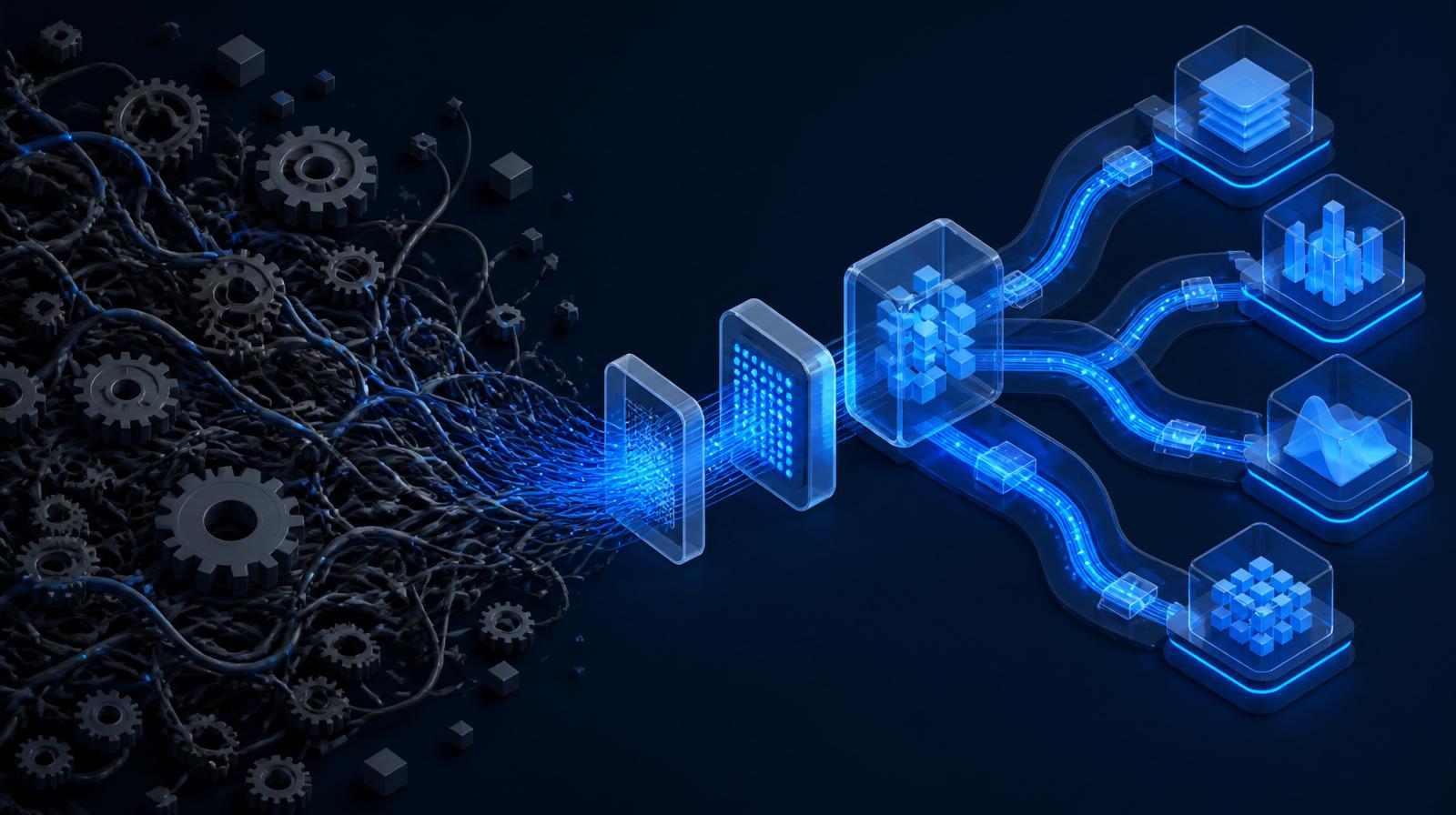 Automation
Intelligent Automation vs. RPA: Which Cuts Costs?
A practical decision framework for choosing between intelligent automation and RPA, with a cost model and the mid-market questions that actually matter.
Read resource AI Strategy
AI Growth Strategy: Turn AI Into Measurable Revenue
A practical AI growth strategy for mid-market companies in 2026 — where to start, which use cases pay back fastest, and how to measure ROI.
Read resource Advisory
Outcome-Based Software Engagements: Buy Results, Not Hours
How to structure an outcome-based software engagement — what it is, when it works, and how it differs from a traditional agency's time-and-materials model.
Read resource