
Stop Automating Broken Processes: The Real Choice Between RPA and Intelligent Automation
Key takeaways
Stop Automating Broken Processes: The Real Choice Between RPA and Intelligent Automation
Shipping and logistics leaders often mistake task speed for systemic efficiency. They deploy bots to move data between a TMS and a legacy portal, only to find their engineering teams spending forty hours a month "fixing the bot" every time a UI element changes. This is the technical debt trap of basic robotics; it mimics human clicks without understanding the underlying business intent.
Choosing between rpa vs intelligent automation determines whether your operation remains reactive or becomes predictive. This guide breaks down the technical and operational differences to help COOs and CTOs determine which level of workflow automation actually moves the needle on margin.
Why Surface-Level Automation Fails in Logistics
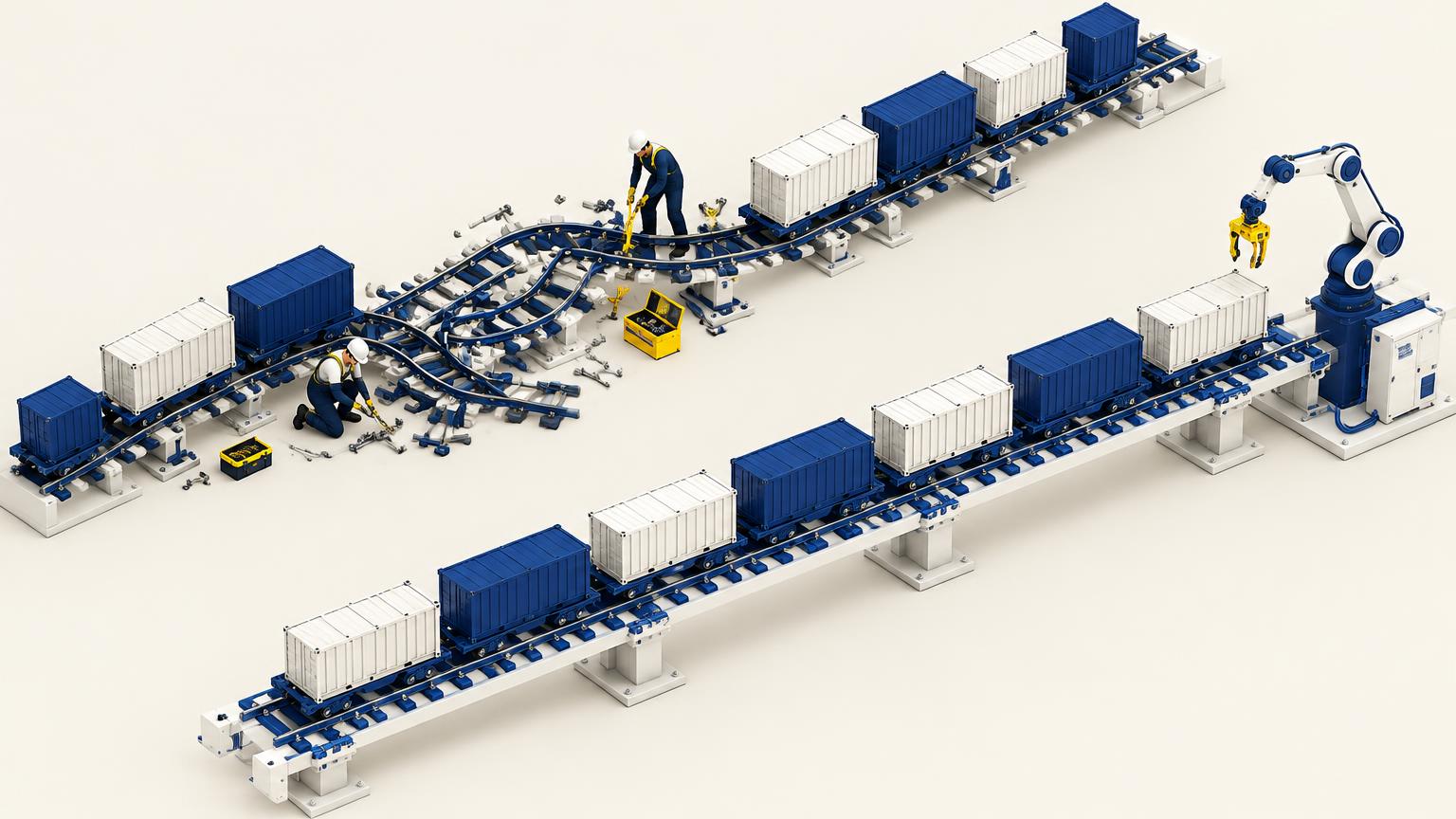
Standard Robotic Process Automation (RPA) mimics a human user by interacting with the user interface. While fast to deploy, it is inherently fragile because it relies on static rules in a high-variance industry.
- Bots break the moment a port authority or carrier updates their web portal layout.
- Rigid scripts cannot handle the "unstructured data" found in emailed PDFs, photos of packing slips, or chaotic chat logs.
- Over-reliance on RPA creates a "spaghetti" architecture where dozens of disconnected scripts run without centralized governance or visibility.
- Scale is limited by the number of virtual machines and licenses required, often costing more in maintenance than the labor it replaced.
The Playbook for Progressive Logistics Automation
1Audit for Decision Complexity
Before selecting a tool, map your processes by the density of decisions required. If a task follows a "if this, then that" logic 100% of the time, RPA is a viable temporary fix. If the task requires interpreting intent—such as identifying a high-priority shipment from a frantic email—you require intelligent automation.
2Prioritize Data Foundations
No amount of process automation can fix poor data hygiene. Intelligent systems require clean, centralized data to train the models that handle exceptions. Structural integrity in your data layer allows AI to predict delays or optimize routes rather than just filing the paperwork for a late delivery.
3Deploy OCR with Machine Learning
Move beyond legacy Optical Character Recognition that looks for text in specific coordinates. Modern intelligent automation uses Computer Vision and Natural Language Processing to extract data from any document format, regardless of layout. This allows your team to ingest thousands of diverse carrier invoices without manual re-entry.
4Build for API-First Connectivity
Treat RPA as a last resort for systems that lack modern integration points. Where possible, use middleware to connect your TMS, ERP, and warehouse management systems directly. This reduces the "brittleness" of your automation and ensures that data flows at the speed of the network, not the speed of an emulated mouse click.
The Maintainability Gap: Why IA Outlasts RPA
The true cost of automation isn't the implementation; it is the "drift" that happens over months of live operation. RPA requires constant babysitting because it lacks a feedback loop. When a bot fails to find a "Submit" button, the process stops, often creating a bottleneck that requires manual intervention to clear.
Intelligent automation incorporates "Human-in-the-Loop" (HITL) workflows. When the system encounters a low-confidence scenario—like a blurred signature on a delivery receipt—it flags the specific issue for a human and learns from the correction. This creates a self-healing system that increases logistics efficiency over time, shifting your staff from data entry clerks to exception managers.
How RND Hub helps
We specialize in helping logistics providers move beyond brittle scripts by building robust AI & Intelligent Automation solutions. Our team bridges the gap between legacy systems and modern efficiency through Custom Product Engineering that prioritizes long-term stability over quick fixes. We start with a high-level executive strategy session to audit your current stack, identify where RPA is creating technical debt, and architect a data foundation that supports enterprise-grade scaling.
Frequently asked questions
When is RPA the right choice over Intelligent Automation?
RPA is appropriate for high-volume, low-complexity tasks involving "closed" legacy systems that do not have APIs. If you need to move data between two stable, internal desktop applications where the UI never changes and the logic is purely binary, RPA is a cost-effective bridge.
How much human oversight is required for Intelligent Automation?
Initially, Intelligent Automation requires "Human-in-the-Loop" monitoring to validate the model's confidence scores. As the system processes more data and learns from human corrections, the "exception rate" typically drops, allowing your team to focus only on the most complex 5% of cases.
Can Intelligent Automation work with handwritten documents?
Yes, using advanced Computer Vision and Deep Learning models, modern systems can extract text and intent from handwritten bills of lading or damaged labels. Unlike traditional RPA, which requires near-perfect digital inputs, these systems are designed to handle the "noise" inherent in physical shipping environments.
What is the typical timeframe to see an ROI on these investments?
RPA often shows immediate tactical ROI within 3 months but plateaus or declines as maintenance costs rise. Intelligent Automation typically takes 6–9 months to fully integrate and train, but it produces a compounding ROI by permanently removing operational bottlenecks and reducing the need for headcount growth during scaling.
Does Intelligent Automation replace our existing TMS or ERP?
No, it acts as an orchestration layer that sits on top of or between your existing core systems. It extracts data, makes decisions, and pushes updates back into your TMS/ERP, extending the life of your legacy investments while adding modern capabilities.
Ready to move on this?
Pick the path that matches where you are today — the RND Hub team can take it from there.
Explore the RND HUB AI Compliance Assistant prevention loop
See how connected fleet signals, explainable analysis, qualified human review, and focused driver education are designed to work together.
Frequently asked questions
Keep reading
All articles AI Strategy
AI Growth Strategy: Turn AI Into Measurable Revenue
A practical AI growth strategy for mid-market companies in 2026 — where to start, which use cases pay back fastest, and how to measure ROI.
Read resource AI Strategy
AI Agents for Operations: The 2026 Playbook
A practical playbook for deploying AI agents inside mid-market operations in 2026 — where they pay back fastest, guardrails that matter, and how to measure real impact.
Read resource AI Strategy
AI Copilots vs. AI Agents: What to Deploy First
A practical guide for mid-market leaders on when to deploy an AI copilot vs. an AI agent — and the decision framework RND Hub uses on real engagements.
Read resource