
The Blueprint for Automating Bill of Lading Processing
Key takeaways
The Blueprint for Automating Bill of Lading Processing
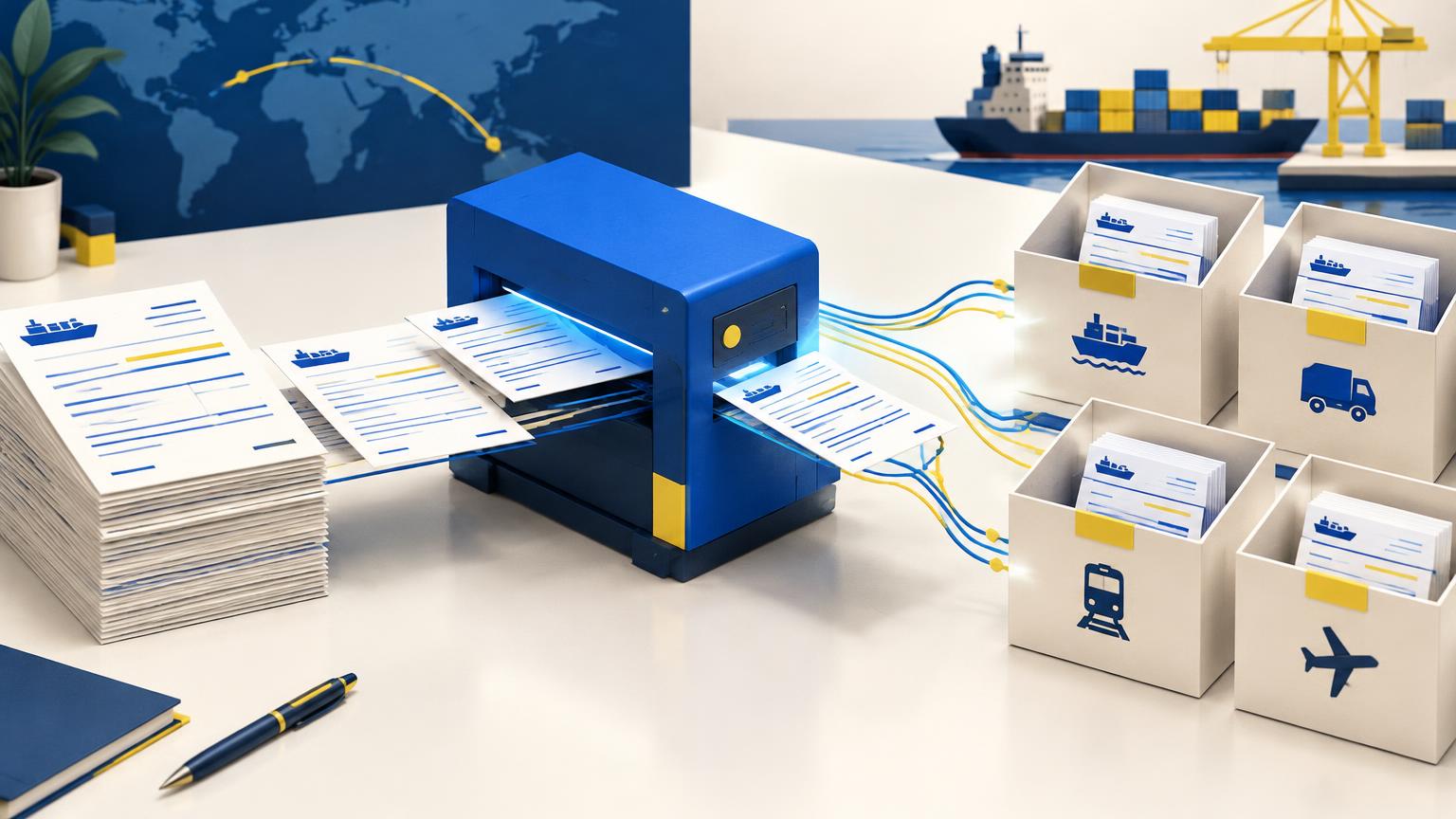
The Bill of Lading is the most important document in the supply chain, yet it remains the biggest driver of operational friction. Most logistics firms still employ teams to manually transcribe handwritten notes, carrier pro numbers, and line-item quantities into dispatch or accounting software. This manual touchpoint isn't just slow; it introduces a 2–5% error rate that compound into billing disputes and lost revenue.
Modern logistics leaders are moving away from rigid, template-reliant systems toward flexible intelligent document processing (IDP). This technical guide outlines how to automate bill of lading workflows to move data at the speed of the physical freight. It is designed for operational leaders who need to eliminate the "paperwork bottleneck" without upending their existing tech stack.
Why traditional OCR fails to automate bill of lading workflows
Traditional Optical Character Recognition (OCR) was built for standardized forms, but the logistics industry has no single standard. When you attempt to scale manual processing using legacy tools, several failures emerge:
- Variation in document layouts across thousands of carriers makes a template-based approach impossible to maintain.
- Low-quality scans, skewed photos from drivers, and handwritten "exceptions" break traditional text extraction logic.
- Contextless data extraction fails to differentiate between a "Total Weight" and a "Pallet Weight" if they appear in similar areas.
- Rigid systems cannot handle multi-page documents where line items flow across several sheets of paper.
The technical framework for unstructured data extraction
Building a resilient BoL automation pipeline requires a shift from "reading text" to "understanding context." Follow these steps to move from scans to structured, actionable data.
1Centralize the intake funnel
Data enters the organization through fragmented channels including driver apps, email attachments, and physical scanners. You must consolidate these into a single landing zone—typically an S3 bucket or Azure Blob storage—to trigger the automation pipeline. Normalizing these inputs into a high-resolution PDF or TIFF format ensures the extraction engine has the highest quality starting point.
2Leverage LLM-based vision models
Ditch the coordinate-based extraction in favor of Large Language Models (LLMs) with vision capabilities. These models don't just look for text at a specific 'X, Y' coordinate; they understand the semantic meaning of the document. This allows the system to identify the Shipper, Consignee, and SKU numbers regardless of where they sit on the page or how the table is formatted.
3Implement a confidence-score gateway
Automation is not an all-or-nothing proposition. Every extraction should return a confidence score for each field; if the model is only 70% sure of a pro number, the system must Route that specific document to a manual review queue. This "human-in-the-loop" architecture ensures 100% data integrity while still automating 80–90% of the total volume.
4Normalize and validate against the source of truth
Extracted data is useless if it doesn't match your system of record. The pipeline should cross-reference extracted carrier names and addresses against your master data to correct minor misspellings or abbreviations. Validating line-item totals against the original purchase order or rate quote catches discrepancies before they reach the billing department.
5Push structured data to the TMS/ERP
The final step is the programmatic injection of data into your Transportation Management System (TMS) via API. By automating the data entry, you trigger downstream workflows like automated invoicing and real-time shipment status updates. This removes the "black hole" period between when a driver signs a BoL and when the back office knows the load is delivered.
The "Data-Cutover" Problem in Logistics
One of the most significant risks in logistics automation is the transition from manual processes to automated streams without losing track of "in-flight" shipments. A "shadow period" often occurs where some documents are being processed by the new AI engine while others are still being keyed in by the legacy team.
To mitigate this, successful teams use a phased rollout based on carrier volume or document complexity. Starting with your top 10 carriers allows you to refine the model's accuracy on high-frequency layouts before tackling the long tail of one-off shipments. This ensures that data foundations and analytics remain consistent across the organization during the migration, preventing an "information gap" that could lead to missed billing cycles.
How RND Hub helps
We specialize in high-stakes process automation and workflow optimization for mid-market logistics and trucking firms. Our team doesn't just hand over a tool; we build the end-to-end pipeline that connects your document intake to your core ERP. Whether you need to solve for unstructured data extraction or modernize a legacy dispatch system, we focus on engineering solutions that deliver measurable ROI on day one.
Frequently asked questions
How does the system handle handwritten notes or signatures on a BoL?
Modern AI models utilize intelligent character recognition (ICR) to interpret handwriting within the context of the document. If a driver writes "2 pallets damaged" in the margin, the system can extract that as a "Note" or "Exception" field and flag it for the claims department. This is a significant leap over older OCR, which would either ignore the text or interpret it as noise.
Can this technology differentiate between a Bill of Lading and a Packing Slip?
Yes, the first step in a modern pipeline is document classification. The model analyzes the structure and keywords of the incoming file to determine its type—BoL, Proof of Delivery (POD), or Invoice. Once classified, the system applies the specific extraction logic relevant to that document type, ensuring high precision.
What happens if the scan quality is extremely poor?
While AI is resilient, it cannot invent data that isn't there. If a scan is too blurry or dark, the system identifies the failure at the processing stage and triggers a notification for a "re-scan." However, modern image enhancement algorithms can often normalize contrast and sharpness before processing to salvage documents that would be unreadable to older systems.
Does automating BoL processing require an expensive rip-and-replace of our TMS?
No, the goal is to enhance your current systems, not replace them. We build "connective tissue" that sits between your inbound documents and your existing software. Most modern TMS platforms have APIs or flat-file import capabilities that allow an automation pipeline to feed them data as if a human had typed it.
How do we handle documents with multiple pages and hundreds of line items?
The pipeline uses recursive logic to process tables that span across pages. The AI identifies the header of the table and continues to extract rows until it identifies a "Total" or "Footer" element. This ensures that complex shipments with high SKU counts are captured accurately without manual intervention.
How long does it take to see a return on investment?
Most organizations see a return within three to six months by calculating the reduction in manual labor hours and the elimination of billing errors. Beyond the direct costs, the secondary value lies in faster invoicing cycles, which improves cash flow and reduces the "Days Sales Outstanding" (DSO) metric.
Ready to move on this?
Pick the path that matches where you are today — the RND Hub team can take it from there.
Explore the RND HUB AI Compliance Assistant prevention loop
See how connected fleet signals, explainable analysis, qualified human review, and focused driver education are designed to work together.
Frequently asked questions
Keep reading
All articles AI Strategy
AI Growth Strategy: Turn AI Into Measurable Revenue
A practical AI growth strategy for mid-market companies in 2026 — where to start, which use cases pay back fastest, and how to measure ROI.
Read resource AI Strategy
AI Agents for Operations: The 2026 Playbook
A practical playbook for deploying AI agents inside mid-market operations in 2026 — where they pay back fastest, guardrails that matter, and how to measure real impact.
Read resource AI Strategy
AI Copilots vs. AI Agents: What to Deploy First
A practical guide for mid-market leaders on when to deploy an AI copilot vs. an AI agent — and the decision framework RND Hub uses on real engagements.
Read resource