
Why Dynamic Density Defines the Next Era of Last-Mile Logistics
Key takeaways
Why Dynamic Density Defines the Next Era of Last-Mile Logistics
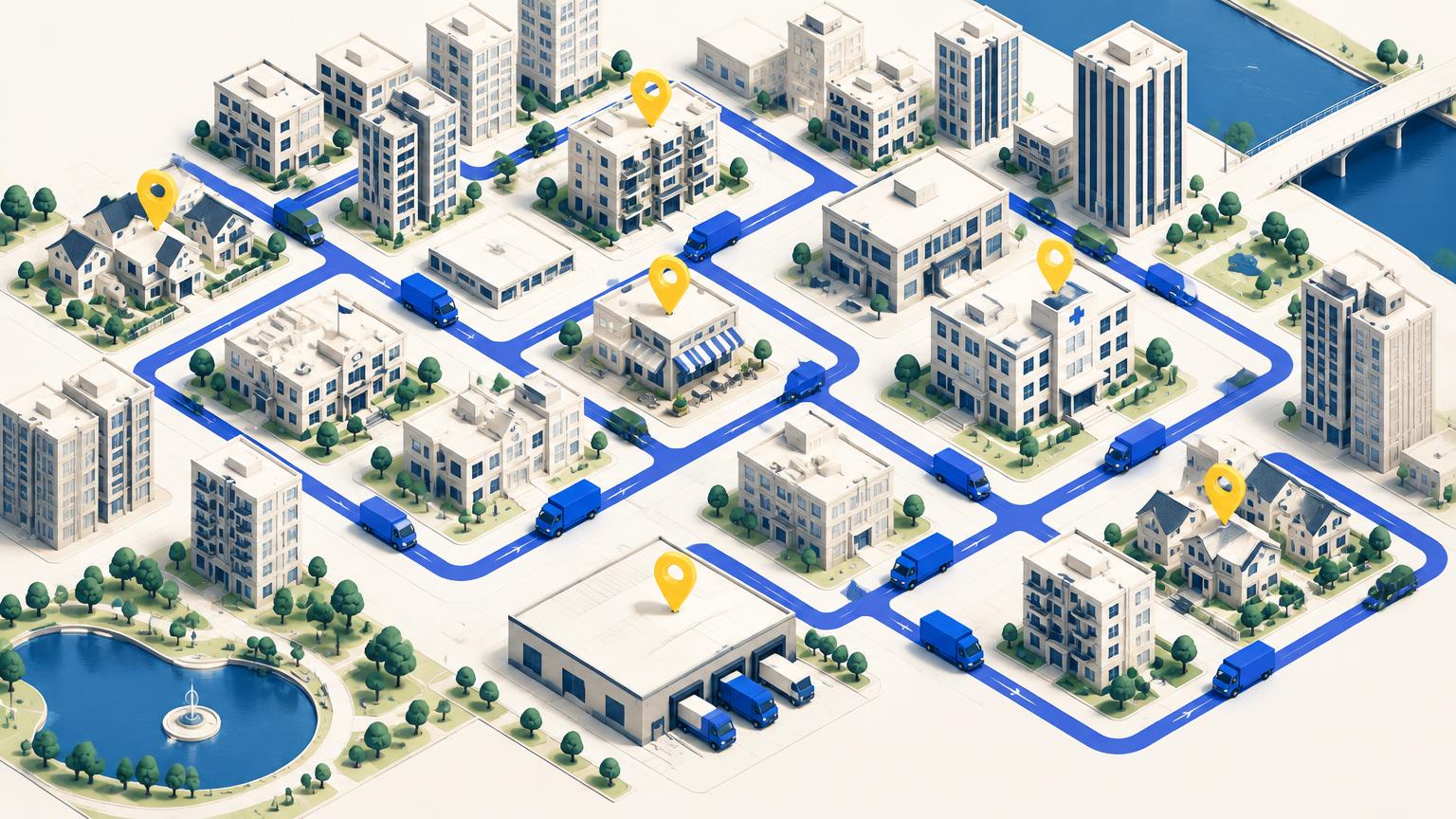
The last mile accounts for a disproportionate share of total shipping costs, yet most operators still rely on legacy "batch and dispatch" logic. These systems treat a delivery route as a fixed geometric problem, ignoring the volatility of turn-by-turn reality. When a driver encounters a closed road or an inaccessible loading dock, the entire schedule cascades into failure, resulting in missed windows and expensive redelivery attempts.
This article outlines how to move beyond basic GPS tracking toward an integrated intelligent logistics framework. We will examine the specific levers that drive down the cost per stop and how mid-market leaders can implement last mile technology to gain a defensive advantage over less agile competitors.
The Structural Failures of Traditional Routing
Classic routing software assumes a "perfect world" execution that rarely exists on the pavement. These systems fail because they treat efficiency as a purely mathematical distance calculation rather than an operational flow.
- Static maps fail to account for hyper-local variables like school zone timing, recurring construction, or seasonal weather patterns.
- Legacy dispatching creates rigid silos that cannot re-optimise a fleet mid-shift when high-priority on-demand orders arrive.
- Ignoring the "stem time"—the duration between the distribution center and the first stop—distorts the true profitability of regional routes.
- Data silos between the warehouse management system and the driver’s handheld device lead to information lag and customer friction.
The Playbook for AI-Driven Delivery Orchestration
1Centralize the Data Foundation
Before deploying any machine learning models, you must unify your historical performance data and real-time telematics. AI requires a clean baseline of actual service times—how long a driver is truly stationary at a specific curb—rather than theoretical estimates. This data foundations and analytics work ensures your algorithms are learning from ground truth, not idealized assumptions.
2Transition to Dynamic Scheduling
Move away from fixed morning routes toward a continuous optimization loop. A dynamic engine re-calculates the entire fleet's sequence every time a new variable enters the system, such as a canceled order or a vehicle breakdown. This maximizes vehicle utilization and ensures that "density" is maintained even as the day’s plan evolves.
3Factor in "Soft" Constraints
Modern route optimization must account for nuances that a standard API might miss, such as vehicle height restrictions or specific customer delivery windows. High-performing systems weight these constraints to prevent drivers from being sent on routes that are legally or physically impossible. This reduces driver frustration and turnover, which are hidden but massive costs in the last mile.
4Enable Predictive Customer Communication
Efficiency is often ruined at the doorstep, not on the road. Use AI to provide customers with hyper-accurate delivery windows that narrow as the driver approaches. If the system predicts a delay based on current traffic, it should automatically trigger a notification, reducing the probability of a "not at home" result and a costly second attempt.
5Harvest Feedback for Continuous Learning
The final step is a closed-loop system where driver feedback and actual completion times are fed back into the model. If a specific delivery point consistently takes ten minutes longer than estimated, the AI should automatically adjust future quotas for that zone. This prevents the "drifting schedule" that plagues many afternoon delivery windows.
The total operational expense of the last-mile segment divided by the number of successful deliveries, accounting for labor, fuel, and vehicle depreciation.
The Data-Cutover Problem in Logistics
One of the primary roadblocks to modernization is the risk of "flying the plane while building it." Mid-market firms often hesitate to upgrade because they fear a total system swap will result in lost orders or fleet-wide confusion during the transition.
The most effective approach is to implement a parallel processing layer that sits on top of legacy system modernization efforts. By piping existing data into an AI-driven optimization engine while keeping the old dispatch UI intact, operators can validate the new routes against the old ones in a "shadow mode." This allows for a risk-mitigated cutover where the team can prove the ROI of the new logic before fully decommissioning the old infrastructure.
How RND Hub helps
We partner with logistics and service leaders to bridge the gap between fragmented legacy systems and modern, automated operations. Our team focuses on building the custom product engineering and workflow automation necessary to make AI in last mile delivery a functional reality rather than a pilot project. We help you move past off-the-shelf limitations by designing a strategy and advisory roadmap that targets your specific bottlenecks, whether that is data silos, poor route density, or manual dispatching overhead.
Frequently asked questions
Does AI routing work for small fleets or only for enterprise-level carriers?
AI-driven optimization provides a higher relative ROI for mid-market fleets because they lack the massive scale to absorb inefficiencies. Even a 5% reduction in fuel and labor through better density can significantly impact the bottom line for a 20-vehicle operation.
How does AI handle the unpredictability of traffic better than standard GPS?
Standard GPS reacts to current traffic, while AI uses historical patterns and multi-source data to predict where traffic will be by the time the driver reaches that specific node. It looks ahead at the entire route duration rather than just the next turn.
Is custom engineering necessary, or can I use an off-the-shelf app?
Off-the-shelf apps work for simple point-to-point delivery but often fail to integrate with complex back-office systems or specialized industry constraints. Custom engineering allows you to own the logic that defines your competitive advantage, such as proprietary loading sequences or unique customer SLAs.
What is the biggest barrier to implementing AI in the last mile?
The primary barrier is usually poor data quality, such as inaccurate address geocoding or missing timestamps from historical deliveries. AI is only as effective as the data foundation it sits on, which is why we prioritize data cleaning and system integration as the first step.
Will AI-driven routing replace my dispatchers?
AI is designed to augment dispatchers by handling the millions of permutations involved in route optimization, allowing the humans to focus on exception handling and driver management. It shifts the dispatcher's role from manual data entry to high-level system oversight.
Ready to move on this?
Pick the path that matches where you are today — the RND Hub team can take it from there.
Explore the RND HUB AI Compliance Assistant prevention loop
See how connected fleet signals, explainable analysis, qualified human review, and focused driver education are designed to work together.
Frequently asked questions
Keep reading
All articles AI Strategy
AI Growth Strategy: Turn AI Into Measurable Revenue
A practical AI growth strategy for mid-market companies in 2026 — where to start, which use cases pay back fastest, and how to measure ROI.
Read resource AI Strategy
AI Agents for Operations: The 2026 Playbook
A practical playbook for deploying AI agents inside mid-market operations in 2026 — where they pay back fastest, guardrails that matter, and how to measure real impact.
Read resource AI Strategy
AI Copilots vs. AI Agents: What to Deploy First
A practical guide for mid-market leaders on when to deploy an AI copilot vs. an AI agent — and the decision framework RND Hub uses on real engagements.
Read resource