
Custom Software vs. Off-the-Shelf: A Mid-Market Decision Framework
Key takeaways
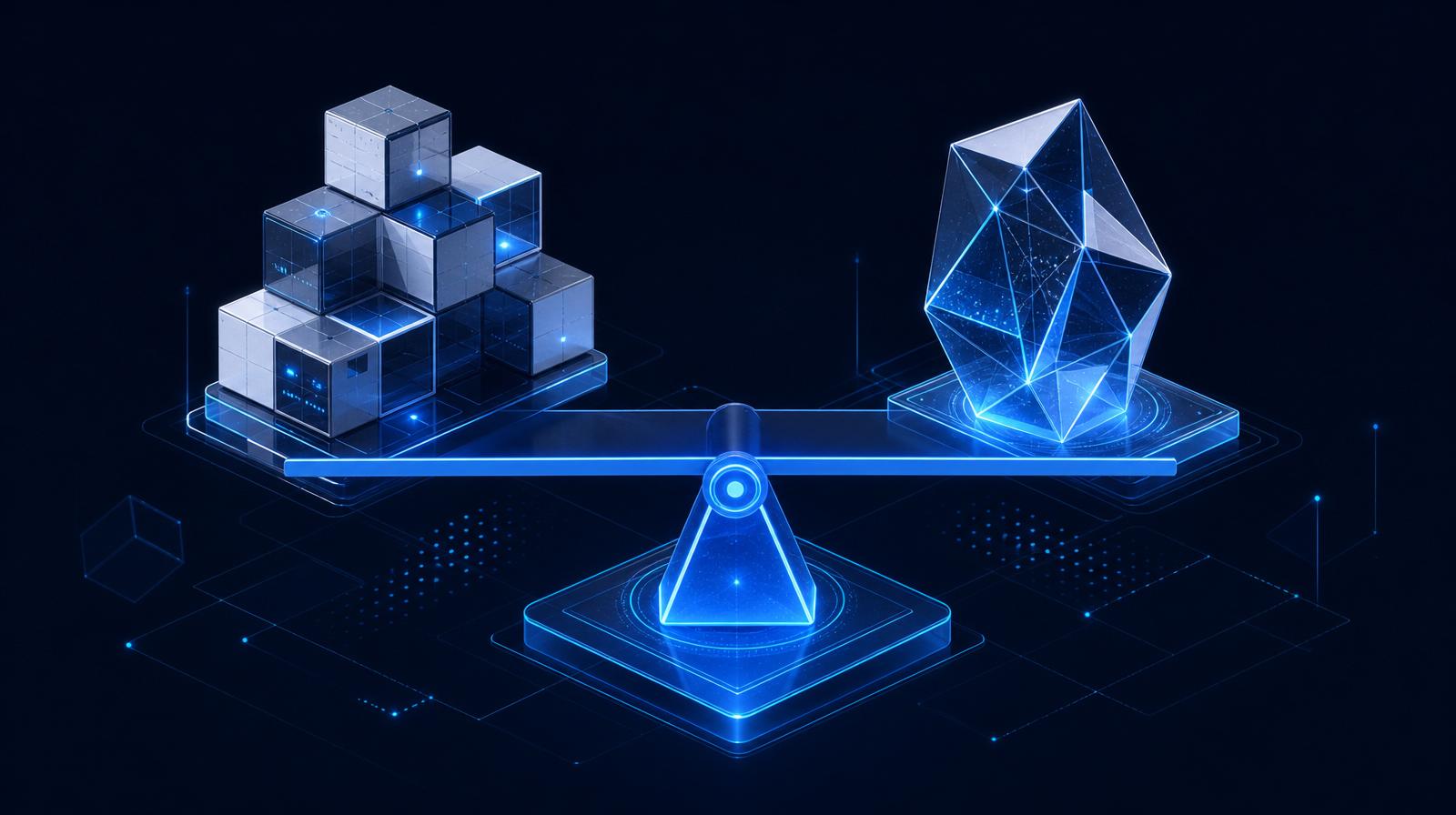
- The build-vs-buy decision is rarely about features — it is about where competitive advantage actually lives.
- Off-the-shelf wins when the process is undifferentiated; custom wins when the process IS the differentiator.
- Total cost of ownership over five years — not license price year one — is the only honest comparison.
- Most mid-market companies end up with a hybrid: buy the commodity layer, build the edge.
- The right question is not 'build or buy' but 'where is our proprietary advantage worth engineering for?'
Every mid-market executive we sit with has been burned at least once by this decision. Either they bought a SaaS platform that fit 70% of the workflow and now the other 30% is duct-taped together in spreadsheets, or they built something custom that shipped six months late, cost twice the estimate, and needs a full-time engineer forever. The pattern repeats because the question itself is framed wrong.
Custom software vs. off-the-shelf is not a technology decision. It is a strategy decision about where your competitive advantage lives and where it doesn't. This guide gives you a defensible framework, a total-cost-of-ownership model that survives contact with reality, and the hybrid pattern most successful mid-market operators end up with.
Why 'build or buy' is the wrong question
Framed as a binary, the build-vs-buy question rewards whoever argues loudest in the room. The right frame is: for each capability in our operation, is this a place where we are trying to be different from competitors, or a place where we just need to keep up? Different-from means custom is on the table. Keeping-up means buy.
The mistake most companies make is treating the entire tech stack as one decision. Payroll is not where you differentiate — buy it. Your proprietary dispatching logic that beats competitors on cost-per-mile? That is exactly where you differentiate — do not hand it to a platform whose roadmap you do not control.
Where off-the-shelf wins
Off-the-shelf software wins whenever the underlying process is a solved problem, standardized across the industry, and unlikely to be a source of durable advantage. Buying is faster, cheaper up front, comes with a vendor roadmap, and does not require you to hire or retain engineers to keep it alive.
- Accounting, payroll, HRIS, expense management — commodity, mature, heavily regulated.
- CRM baseline (contact management, deal tracking, email sync) — every credible vendor solves this well.
- Communications, video, docs, e-signature — utility layer, no advantage in owning it.
- Standard e-commerce checkout, subscription billing — solved by Shopify, Stripe, and their peers.
- Support ticketing, helpdesk, knowledge base — well-defined workflow, mature market.
Where custom wins
Custom software wins whenever the workflow IS the competitive edge — when your ability to execute a specific process faster, cheaper, or more accurately than competitors is the reason customers pick you. In those spots, adopting a SaaS platform means adopting your competitors' operating model, which by definition eliminates the edge.
- Pricing engines, dispatching, load matching, dynamic routing — where the algorithm IS the margin.
- Underwriting, credit decisioning, claims triage — where speed and accuracy of the decision drive P&L.
- Customer-facing product experiences unique to your brand — never rent your brand from a template.
- Proprietary data pipelines and analytics that compound as you operate — the moat grows with usage.
- Regulated or niche workflows no vendor covers well enough to bet the business on.
The 5-year TCO model
Most build-vs-buy comparisons cheat by comparing year-one license fees against year-one build cost. The honest comparison is five-year total cost of ownership, and the numbers usually surprise both sides.
Off-the-shelf year 1
License + implementation + integration + change mgmt.
Off-the-shelf year 5
License compounding + workarounds + integration debt.
Custom year 1
Build + integration + change mgmt (higher up front).
Custom year 5
Maintenance + evolution (flat or shrinking as it matures).
Off-the-shelf and custom software carry different license, implementation, integration, maintenance, and change costs. Whether custom is cheaper depends on usage, differentiation, vendor terms, and the five-year operating model.
The hybrid pattern most operators land on
The mid-market companies that get this right almost never end up all-custom or all-SaaS. They land on a hybrid: buy the commodity layer (accounting, HRIS, comms, CRM baseline), build the differentiated layer (pricing, dispatch, underwriting, proprietary customer experience), and invest heavily in the integration seam between them.
This is the pattern behind almost every mid-market operator we work with. Our trucking case study is a textbook example — the CRM is bought, the general ledger is bought, but the load-matching and driver-recruiting engines are custom because that is where the margin lives. See it play out in the
- 1Map every capability in the business.
- 2Score each on 'differentiator vs. keeping up.'
- 3Buy every keeping-up capability. Don't over-shop — pick, integrate, move on.
- 4Custom-build every differentiator, sequenced so the highest-leverage one ships first.
- 5Invest in the integration layer — this is where hybrid architectures live or die.
How RND Hub helps
RND Hub runs the differentiator map with your leadership team, models the 5-year TCO for each capability, and — when the answer is custom — builds it as a strategic technology partner rather than a staff-augmentation vendor. The commercial model is tied to the outcome, not to developer hours. If you are wrestling with a build-vs-buy call and want a second opinion grounded in operator experience, a working session is the fastest way to get one.
Explore the RND HUB AI Compliance Assistant prevention loop
See how connected fleet signals, explainable analysis, qualified human review, and focused driver education are designed to work together.
Frequently asked questions
- How do I decide between custom software and off-the-shelf?
- Decide capability by capability, not stack-wide. For each workflow, ask whether it is a place where you differentiate from competitors or a place where you just need to keep up. Buy every keeping-up capability. Custom-build every differentiator, sequenced by business impact.
- Is custom software more expensive than SaaS?
- Neither option is universally cheaper. Compare five-year license, implementation, integration, maintenance, staffing, switching, and change costs for the specific workflow.
- When should we build custom software?
- Build custom when the workflow IS your competitive edge — pricing, dispatch, underwriting, proprietary customer experience — or when no vendor covers your regulated or niche process well enough. Never build what commodity SaaS solves well.
- What is the biggest hidden cost of SaaS?
- Integration and workaround debt can become a major hidden cost. Measure the actual manual work and side systems required by the shortlisted product before deciding.
- Do we need in-house engineers to run custom software?
- Not necessarily. A strategic technology partner can own the build, run the maintenance, and evolve the platform on a retained model — you get the differentiator without the hiring risk. In-house engineers make sense once the custom surface area is large enough to keep them fully occupied.
- What is the hybrid build-vs-buy pattern?
- Buy the commodity layer (accounting, HRIS, comms, CRM baseline), build the differentiated layer (pricing, dispatch, underwriting, proprietary customer experience), and invest in the integration seam between them. This is where the majority of successful mid-market technology strategies land.
Keep reading
All articles Advisory
How to Choose a Strategic Technology Partner (Not a Dev Shop)
A buyer scorecard for choosing a strategic technology partner — the red flags that separate a real partner from a staff-augmentation vendor, and the RFP questions that surface both.
Read resource Advisory
Outcome-Based Software Engagements: Buy Results, Not Hours
How to structure an outcome-based software engagement — what it is, when it works, and how it differs from a traditional agency's time-and-materials model.
Read resource Modernization
Legacy System Modernization: A 6-Step Playbook
How to modernize legacy systems without breaking the business — a risk-managed 6-step playbook covering discovery, strangler-fig migration, and rollback.
Read resource