
Operational Decoupling: Scaling Logistics Without the Monolith
Key takeaways
Operational Decoupling: Scaling Logistics Without the Monolith
Most logistics firms are tethered to a "God-box"—a single, massive Transportation Management System (TMS) where every line of code knows about every other line. When you try to update the routing logic to account for new fuel surcharges, the dispatch module breaks, and the mobile app stops syncing. This interdependency creates a "deployment fear" that slows innovation to a crawl, leaving mid-market players unable to compete with tech-native giants.
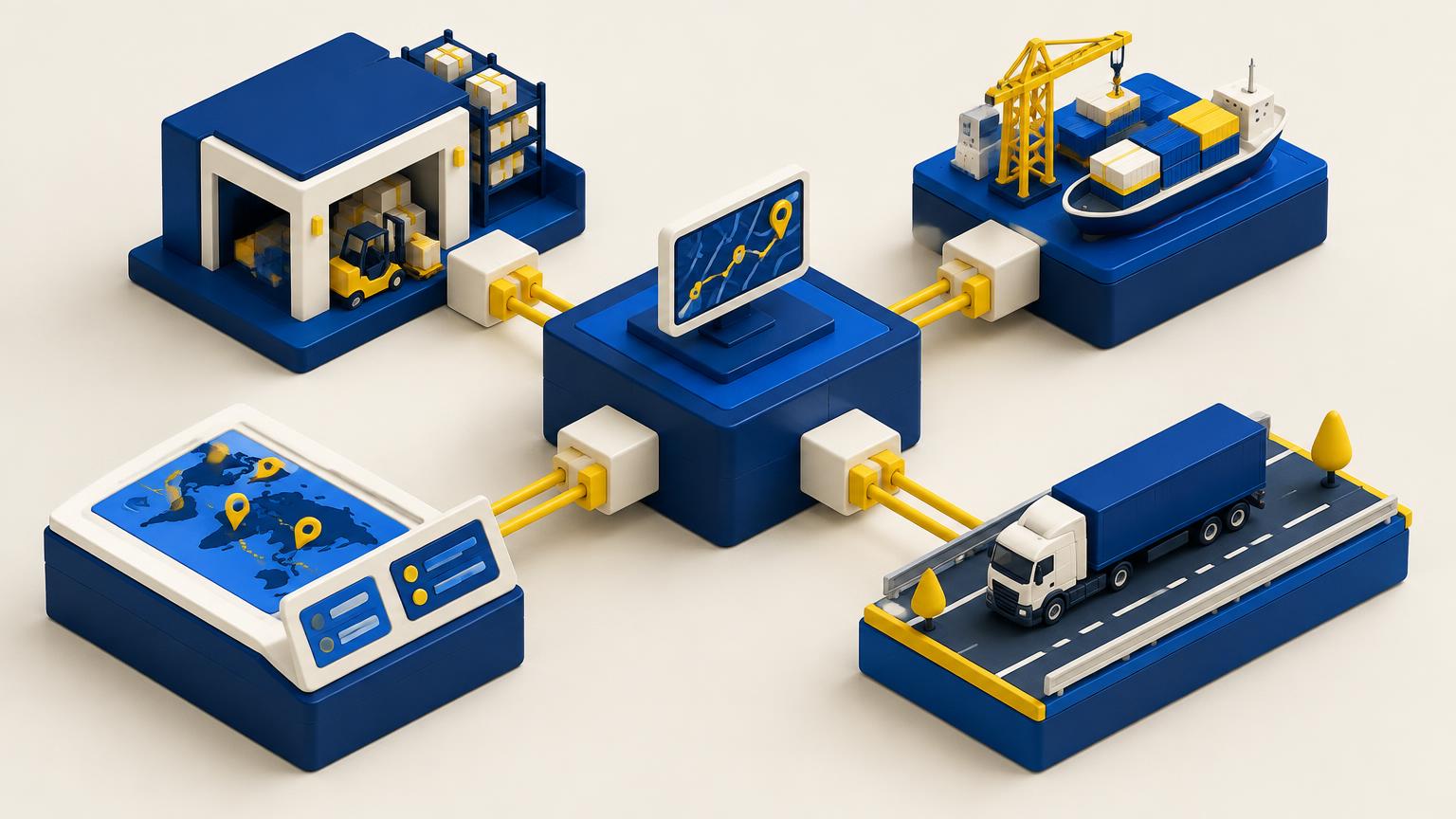
Moving to microservices in logistics is the process of turning that brittle block into a fleet of specialized instruments. This guide outlines the blueprint for decomposing dispatch, billing, and routing into autonomous services that scale on demand. It is written for technical leaders and COOs who need to increase system resilience and developer velocity without risking a total "rip and replace" disaster.
Why Monolithic Logistics Systems Fail at Scale
The primary friction in a monolith isn't the code; it’s the lack of boundaries between business domains. As transaction volumes grow, three structural flaws inevitably emerge:
- Resource contention occurs when a heavy reporting job locks the database tables needed by drivers to check in at a warehouse.
- Deployment risk forces the entire company to take downtime for a minor update to the carrier onboarding portal.
- Talent bottlenecks arise because new developers must understand 500,000 lines of legacy code before they can fix a simple GPS polling error.
- Rigid technology prevents teams from using specialized tools, such as a graph database for complex route optimization, because they are stuck with the main relational database.
The Playbook for Logistics Decoupling
1Identify Bounded Contexts
Before touching the code, map out the business domains that change at different speeds. Dispatch is high-velocity and operational; billing is high-precision and transactional; routing is compute-intensive and algorithmic. Each of these represents a natural boundary for a microservice, ensuring that a surge in route-calculations won't delay an invoice generation.
2Extract Data Before Logic
The biggest mistake in legacy system modernization is moving the code but leaving a shared database. Give each service its own "private" database that no other service can access directly. If dispatch needs driver data from the HR service, it must ask via an API or subscribe to a data event, preventing hidden dependencies that cause cascading failures.
3Implement Asynchronous Messaging
In a decoupled system, services shouldn't wait for each other to finish a task. When a load is delivered, the Dispatch service should simply publish an "OrderDelivered" event to a message broker. The Billing service picks up that event five seconds later to start the invoice, and the Analytics service logs it for data foundations & analytics reporting, all without blocking the driver's next move.
4Build for Partial Failure
Accept that network calls will fail and parts of your system will go offline. Design the dispatch interface so that if the external Weather API or the internal Routing service is down, the dispatcher can still manually assign a load. Use "circuit breakers" to stop requests to a failing service before it drags down the entire infrastructure.
The Strangler-Fig Migration Strategy
You cannot stop the business for two years to rewrite the platform. The Strangler-Fig pattern involves building new microservices around the edges of the monolith, slowly "strangling" the old system until it can be retired.
- Proxy the Traffic: Place an API Gateway in front of your legacy system to route specific requests (e.g., all `/routing` calls) to the new microservice while sending everything else to the old TMS.
- Synchronize Records: Use Change Data Capture (CDC) to keep the legacy database in sync with the new service's database during the transition period.
- Cut Over by Function: Migrate one slice of the business—such as the customer portal—completely before moving to more complex internal operations like payroll.
This captures how often code changes are successfully pushed to production, serving as the ultimate test of whether your microservices have actually reduced friction.
How RND Hub helps
Moving to a distributed architecture requires more than just cloud credits; it requires a disciplined roadmap for software decoupling that respects your daily operational pulse. RND Hub specializes in custom product engineering and legacy modernization for the logistics sector, helping firms transition from fragile monoliths to scalable, event-driven architectures. We focus on high-impact extractions—like separating your routing engine from your core ledger—to deliver immediate ROI while building a more resilient foundation.
Frequently asked questions
Won't moving to microservices increase our cloud hosting costs?
Initially, yes—running multiple small services and a message broker can be more expensive than one large server. However, you gain the ability to scale only what is necessary, such as ramping up routing clusters during peak season while keeping billing servers small. The real cost saving comes from the massive reduction in downtime and the increased speed of your internal development team.
How do we handle transactions across different services?
Standard "all or nothing" database transactions don't work across microservices. We use the Saga Pattern, where a series of local transactions are coordinated via events. If a "Book Load" step succeeds but the "Reserve Truck" step fails, the system automatically triggers a "Compensating Transaction" to roll back the initial booking, ensuring data consistency without a shared database.
Does this require a total overhaul of our DevOps team?
It requires a shift toward automation. Since you are managing 10 services instead of one, manual deployments are no longer viable. You will need to invest in robust CI/CD pipelines and centralized logging so that your team can track a single shipment's journey through multiple independent services without getting lost in the logs.
When is a monolith actually better than microservices?
If your logistics operation is small, has a stable feature set, and isn't experiencing performance bottlenecks, the complexity of microservices may not be worth it. Microservices solve the "problem of scale"—both in terms of traffic and the number of developers working on the code. If you aren't feeling the pain of "deployment fear" or slow release cycles, stay monolithic as long as possible.
How do we ensure "source of truth" for shipment status?
Each piece of data must have exactly one owner. The Shipment service owns the status; every other service (Billing, Tracking, Customer Portal) only keeps a read-only copy of that status which it updates via events. By designating a single authoritative service for each data type, you eliminate the "split-brain" scenarios where the portal says a load is in transit but the dispatcher sees it as delivered.
Ready to move on this?
Pick the path that matches where you are today — the RND Hub team can take it from there.
Explore the RND HUB AI Compliance Assistant prevention loop
See how connected fleet signals, explainable analysis, qualified human review, and focused driver education are designed to work together.
Frequently asked questions
Keep reading
All articles AI Strategy
AI Growth Strategy: Turn AI Into Measurable Revenue
A practical AI growth strategy for mid-market companies in 2026 — where to start, which use cases pay back fastest, and how to measure ROI.
Read resource AI Strategy
AI Agents for Operations: The 2026 Playbook
A practical playbook for deploying AI agents inside mid-market operations in 2026 — where they pay back fastest, guardrails that matter, and how to measure real impact.
Read resource AI Strategy
AI Copilots vs. AI Agents: What to Deploy First
A practical guide for mid-market leaders on when to deploy an AI copilot vs. an AI agent — and the decision framework RND Hub uses on real engagements.
Read resource